What to do in
Guayaquil – Ecuador
Guayaquil, officially
Santiago de Guayaquil, is the largest and the most welcoming city in Ecuador,
as well as that nation's main port and one of the main South American ports
in the Pacific. Guayaquil is located on
the western bank of the Guayas River, which flows into the Pacific Ocean at the
Gulf of Guayaquil. Because of its location, the city is an important center of commerce with regional
influence in areas of business, finance, culture and entertainment.
Guayaquil
offers travelers a surprising number of sights and activities. It boasts
museums, historic neighborhoods, sprawling parks and waterfront strips, carved
by the rivers and estuaries, which find their outlet to the sea. Guayaquil
offers visitors a blend of nature, history, and tradition. A
proud city of the tropics where foreigners are well received, music rules and
seafood is a must.
If you are planning to visit the Galapagos
Islands, Guayaquil is the smartest place to take a flight
from. Guayaquil is the closest point from Ecuadorian mainland to the Galapagos,
an all the domestic flights do stopover in Guayaquil to get refuel and pick up more
passengers.
Guayaquil's airport was
awarded to be one of the best airports in South America, is open 24
hours and offers connections to every country in South America also have nonstop
flights to Europe and the USA. In the main
terminal on arrival there are several eateries to choose from including a few international
chains.
It's
also a lot more convenient to fly from Guayaquil to Galapagos or Lima, because
it is at sea level and tourists do not get the high-altitude sickness. It is also
easier to get to Cuenca if you are travelling there overland and finally the
airport is very close to downtown, so you can star enjoying this
beautiful city the as soon as you arrive.
- Parque Histórico (Historic Park)

Parque historico was built it in 1997 on the banks of the Guayas River as a theme park of 8
hectares with educational, cultural, environmental, recreational and tourist
purposes. It is aimed to exhibit the history and culture of the old province of
Guayaquil that emerged at the end of the colonial times and the beginning of
the republican life of the country between the XIX and XX centuries, which
occupied almost all of the Ecuadorian coast including the existing provinces of
Los Rios, El Oro and part of Manabí.
The
site also recreates the architecture, traditions and the urban and rural life
of the Guayaquil of those times, mixed with a beautiful natural park full of a
diverse vegetation that form different natural and wildlife areas with their
respective flora and fauna.
The hotel del Parque benefits from its exclusive setting within the
Parque Historico Guayaquil
Attractions: the visitors can get a taste of the geopolitical context of the
old days; since the park recreates different habitats in which the people of
the old province of Guayaquil
used to develop their activities, such as the woods, the countryside and the city,
which is closely related to the so called “Golden Age” of the main port of
Ecuador, whose principal activity was the commercialization of cocoa.
The
visitor can appreciate the history of Guayaquil in three defined areas:
1) Wildlife Area: it comprises approximately four hectares and recreates the natural
habitat of more than 50 species between birds, mammals and other animals that
turned the woods into their natural habitat, some of which are in danger of
extinction.
2) Urban Architectonic Area: the space recreates the wealthy times of
Guayaquil of the first decades of the XX century, when the city enjoyed an
economic boom thanks to the growth and exportation of cocoa, which brought
prosperity to the city and the surrounding farms.
3) Traditional Area: the space of two hectares is a place of reminiscence in which the
visitor can learn about the history of urban Guayaquil, besides the observation
of the rural life of our countryside.
The
tourists will be immersed in the era known as “Pepa de Oro” because of the
cocoa boom, and will be guided through a cocoa farm in which they will be able
to see all the production process of chocolate.
Las Peñas Neighborhood (Heritage)

History
With
more than 400 years old, Las Peñas was the first neighborhood of Guayaquil,
which took its name from the cliffs and limestone rocks that formed the Hill
back then when the Spanish settled in the XV century. In 1982 the neighborhood
was declared Cultural Heritage of Ecuador and between 2002 and 2008, the place
was restored and regenerated by the Municipality of Guayaquil.
This
neighborhood, born in Colonial times, was destroyed in several occasions by the
fires that assailed the city. The fact that the neighborhood was rebuilt in
times of the Republic alienated its colonial style.
It
has a unique architectonic style and is a spectacular place for being located
at the hill and in front of the river, also for its colorful and romantic
appearance of narrow and cobbled streets with a bohemian ambiance.
Diego
Noboa Staircases
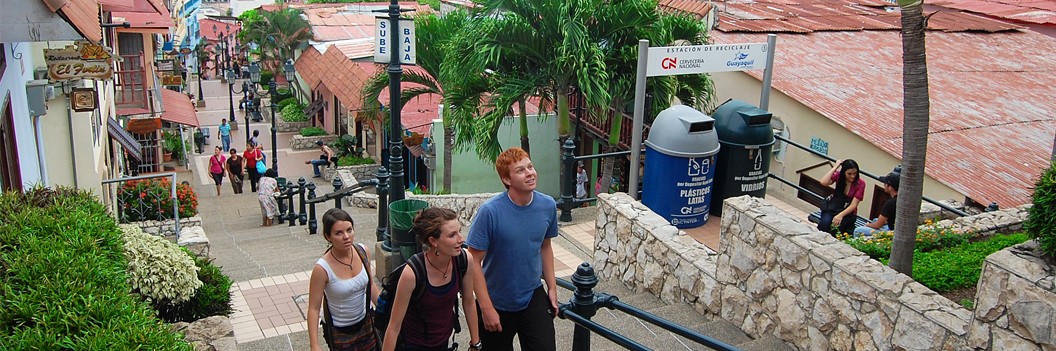
The
staircases are one of the favorite tourist destinations because it has symbolic
places of the culture of Guayaquil, besides entertainment places.
It starts at the foot of
the hill and end at the top. It is formed by 444 numbered stairs in which the
tourists can find squares, roundabouts, museums, a chapel, a lighthouse, art
galleries, craft shops, Internet coffee places, bars and restaurants.
Simón Bolívar Pier

History
This
urban park, filled with nature, history, tradition and modern beauty is a
touristic attraction that has a length of 2,5 kilometers (26 blocks). Visitors
can find gardens, artificial lagoons, water fountains, viewpoints, docks,
squares and historical monuments like The Rotunda Hemicycle, Moorish Tower,
Aurora Gloriosa (Glorious Dawn) and the statue of Olmedo. As well as museums,
movie theatres, shopping centers, restaurants, bars, food courts, playgrounds,
a crafts market and all of the attractions, services and commodities that a
tourist needs to enjoy a tour through the city. It also offers tours through
the Guayas River in which the city can be seen from another geographic point,
within an imposing natural environment of great beauty.
Crafts Marker of the Pier
Its
location gives an ambiance of beauty due to its natural surroundings, since it
is near the Guayas River and close to an area of gardens, trees, and
contemplation and rest spaces.
Its
main attraction, on a touristic level, are 24 stores that offer good prices, it
has several crafts that depict the national folklore crafted by hand by
Ecuadorian artisans in materials such as cloth, wood, leather, ceramic, stone,
tagua, glass, balsa wood, toquilla straw, steel, copper, among others.

Access: the
visitor can access the Island by foot, by bicycle or by the river. The access
for pedestrians and bicycles is through a bridge located in Guayaquil, in El
Oro Street, next to the river.
The
tourists can take boats that are anchored in the docks of the Yacht Club of
Guayaquil to access the Island by the river, which is located diagonal to the
Municipal Palace (Palmeras de Santay Cooperative).
The
Island was not only recognized locally, regionally and nationally, but for its
ecological characteristics and for the dedication of the population to the
conservation, it was recognized internationally as a Ramsar place, award that
highlights the importance of these ecosystems as fundamental for global
conservation and sustainable use of biodiversity.
The
Island is home to 85 bird species, 12 reptiles like the boa and the iguana;
mammals like the raccoon, the anteater bear and the bat. Catfish, sea bass,
tilapias, which are used for consumption and sale, form the aquatic fauna.
Species like the black mangrove; guachapeli and Saman trees (endemic species)
can also be appreciated.

Go over Simon Bolivar Pier and enjoy of:
·
Its big group of sculptures with a length of 2.5 km
·
You can do your shopping in the Malecon 2000 mall
·
Visit the craft market located in the south wing
·
Visit the renewed South Market (Cristal Palace)
·
The beautiful gardens and fountains
·
The exercises zone and the Safari Park for the kids.
While you are on the Simon Bolivar Pier you can make lots of activities
The Ferris Wheel "La Perla", offers an
entertaining ride for tourists, who can admire the city from the top. With 57
meters high it is the highest wheel of South America, and
is located in the northern part of the Simon Bolivar Pier. The wheel completes
its journey in 12 minutes.
- Rides for the Guayas River on board of the Henry Morgan boat.
- Rides for the Guayas river on fiber boats.
- Travel the city in Guayaquil vision bus
- Visit the museums located in the Simon bolivar pier
- miniature museum “Guayaquil in the history
- Anthropological museum and contemporary art (Maac)
- Enjoy a movie or a documentary in the malecon cinema

Take
a beautiful walk by the Pier of the Salado Estuary. While walking the pier you
will be able to do several activities like:
- Walk by The Rodolfo Baquerizo Square
- Walk by the 5 de Junio bridge and have a panoramic of 9 de Octubre Boulevard
- Walk by the Writers walk
- Enjoy of Nautical Rides of Salado Estuary
If you are at the lineal park at night you cannot miss the Monumental
Fountain of Dancing Waters show.
Walk the Lineal Park:
A few meters from the Pier del Salado Estuary, is the lineal park with 21.000 square meters of construction and several resting areas, exercise, that goes from contemporary art and monuments on illustrious figures,
A few meters from the Pier del Salado Estuary, is the lineal park with 21.000 square meters of construction and several resting areas, exercise, that goes from contemporary art and monuments on illustrious figures,
Zigzag Bridge (Youth Walk)
If you enjoy walking and admire the natural landscapes, continue the walk from the Lineal Park to the Zigzag Bridge. A bridge of modern architecture decorated with verticals roundabouts gardens and a beautiful view of the Salado Estuary.
If you enjoy walking and admire the natural landscapes, continue the walk from the Lineal Park to the Zigzag Bridge. A bridge of modern architecture decorated with verticals roundabouts gardens and a beautiful view of the Salado Estuary.
Continuing with the walking
by the Zigzag Bridge you will get to the Victor Emilio Estrada Pier that
connects with the Guayaquil University and Urdesa, one of the busiest place in
the city.
El
Velero Bridge

A milestone in the urban aesthetics of Guayaquil, standing out as "The most
beautiful bridge of the country".
It has an architectural
design of modern style that simulates the shape of a sailboat and the natural
surroundings of the Salado Estuary. At night, it offers great splendor, when
its sails of canvas and fiber optic cable system illuminate in blue.
Firefighters
Museum

History
There
is an exhibition inside the museum that presents old water pumps, tools,
uniforms and awards, besides valuable oil paintings and portraits of the Fire
Department Commanders. Also, animal-drawn carts from the end of the XX century
until the modern vehicles of today.
A
water fountain from 1902 can be appreciated in the small square of the museum.
Another attraction is a semicircle that houses the busts of the chiefs of the
Fire Department.
Santa
Ana Port

History
It
Is a touristic building complex of 4 hectares formed by several office
buildings, commercial shops, apartments, squares, museums and a pier that
borders the Guayas river.
It is surrounded by a
natural landscape since is located in front of the Guayas River; it has a
modern architecture with a building constructed in the same place where the
silos of the National Brewery used to be located, which maintains its original
design. There is the Pilsener Square in which several artistic events take
place and also the museums that pay tribute to Julio Jaramillo, the Beer
industry and Barcelona Sporting Club.
Civic
Square

History
The Civic Square comprises
famous monuments like the Rotunda Hemicycle to Bolivar and San Martin, the
Moorish Tower (public clock), the President`s Walkway (monuments to former
presidents from Guayaquil) and also peculiar sculptures like the Wild Boar. It’s
the home of two traditional Clubs: The Naval Club and the Yacht Club that have
been incorporated to the project respecting their access and private
requirements. The Square also has four sculptures that evoke popular culture
and represent the four elements of nature (earth, air, fire and water), two of
them transformed into viewpoints, which provide the visitor a privileged view
of the city and its surroundings. There is also an esplanade with a series of
water fountains that create an exceptional environment at night.
One
of its main architectonic attractions is a great portion of its area
(approximately 10 thousand square meters) that was reclaimed from the river by
a reinforced concrete base, on a pilot foundation, which approaches the city to
its quite river.
Olmedo
Square

The
square pays tribute to Jose Joaquin de Olmedo, hero of Guayaquil, former mayor
of the city and precursor of the Revolution of October 9, 1820.
The
monument is placed within a group of cylindrical water fountains and next to
the traditional Union Club, meeting place of Guayaquil’s society, founded in
1869. The Square has several viewpoints and a terrace in front of the river
that connects with other places of the Pier through a pedestrian wooden bridge.
Benches have been placed along the corridors for the people to rest, and next
to them giant skylights that give the place a maritime style.
Seminario
Park

The
existing park was built in the XIX century, in 1868, which had a huge eight-point
star, reason why the park was called Plaza de la Estrella (Star Square). In
1889, the equestrian monument to Simon Bolivar was built and the place was
renamed as Plaza Bolivar (Bolivar Square). By then, philanthropist Manuel
Seminario made an important donation to renovate the park that took the last
name of the illustrious citizen.
Also
known as Parque de las Iguanas (Iguana Park) for the large population of
iguanas in the place, it has a natural charm because of the tress and
artificial lagoon in which swim different colored fish.
THE IGUANAS, A NATURAL ATTRACTION
The
iguana is classic specie from Guayaquil and is visible in different areas of
the city. According to biologists, they settled in the early days of the city,
during the colonial times, because water, mangroves and willow trees surround
the city, whose fruits are their favorite food. The parks are filled with their
presence due to their proximity to the river and because people did not pursue
them, since it is not edible specie in our diet.
Seminario
Park is also known as the Iguana Park, since dozens of iguanas live in its
ornate gardens. According to the tourists they give a prehistoric and natural
ambiance to the Park. The reptiles that measure up to 1 meter in length are the
main attraction of the Park and mingle amiably among the people.
Centenary Square

It
was inaugurated in October 9 of 1920, as the pinnacle work of the celebration
for the commemoration of the 100 years of Guayaquil’s independence.
The
square, one of the largest of the city, has 8.875 square meters and follows the
traditional architectural detailing of the Sacred Woods of Classic Greece.
It
has several attractions in which statues of great value stand out, which are
surrounded by beautiful gardens.
The
monument called “The Column to National Heroes”, crafted by Spanish sculptor
Agustin Querol is located in the center of the Square, which pays tribute to
the heroes of the independence deed of October 9 of 1820 that marked the local
emancipation.
There are different statues
in every gate of the square, each one with great symbolic significance. The
“Fountain of the Lions” is located at the southwest corner of the Square.


